Gift Aid: The Free Money Most Charities Aren’t Claiming Enough Of
Gift Aid: The Free Money Most Charities Aren’t Claiming Enough Of
If you run a charity, you’ve probably heard of Gift Aid. But do you know just how much value it can add, or whether your charity is making the most of it?
The good news: Gift Aid is one of the most straightforward ways to boost your charity’s income without asking donors for a single extra penny. Here’s everything you need to know.
What Is Gift Aid?
Gift Aid is a UK government scheme that allows charities to reclaim the basic rate of income tax on donations made by eligible UK taxpayers (excluding Company donations). For every £1 a donor gives, your charity can claim an extra 25p from HMRC, completely free, on top of what you’ve already received.
That means a £100 donation becomes £125. A £1,000 donation becomes £1,250. It adds up quickly.
Who Can Claim Gift Aid?
To claim Gift Aid, your organisation must be:
- Recognised by HMRC as a charity (or Community Amateur Sports Club)
- Based in the UK, EU, Iceland, Liechtenstein, or Norway
- Using donations for charitable purposes only
If you’re not yet registered with HMRC as a charity, that’s the first step, and it’s worth doing sooner rather than later.
What Donations Qualify?
Not every donation automatically qualifies. For a gift to be eligible for Gift Aid, it must:
- Be a cash donation (or card payment, cheque, direct debit, not goods or services)
- Come from a UK taxpayer who has paid at least as much Income Tax or Capital Gains Tax as the charity claims back in that tax year
- Be accompanied by a valid Gift Aid declaration from the donor
That last point is important. Without a declaration, you can’t claim, even if the donor is a taxpayer.
What Is a Gift Aid Declaration?
A Gift Aid declaration is simply a statement from the donor confirming:
- Their name and home address
- That they’re a UK taxpayer (an individual not a company)
- That they’re happy for the charity to claim Gift Aid on their donation(s)
Declarations can cover a single donation, all past donations, or all future donations, so once a regular donor has signed one, you’re covered going forward. They can be collected on paper, online, or verbally (though verbal declarations need to be confirmed in writing).
Why Is Gift Aid Such a Good Thing?
It’s essentially free income. Donors don’t pay more. The government tops up what you’ve already received. For charities working hard to stretch every pound, it’s a genuinely powerful tool.
Here’s a quick example of the impact:
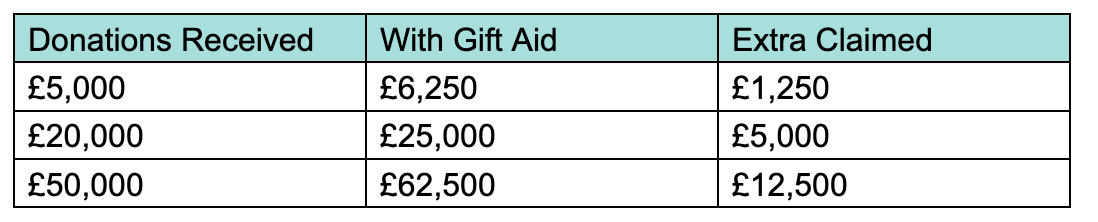
That money can go directly back into your cause, no strings attached.
What About Higher Rate Taxpayers?
If a donor pays the higher rate of tax (40%), they can personally claim the difference between the higher rate and the basic rate through their Self Assessment tax return. That’s an additional benefit for your donors and worth mentioning to them, as it can encourage more generous giving.
The Gift Aid Small Donations Scheme (GASDS)
Not every donation comes with a declaration, especially cash collections, buckets, or contactless taps at events. That’s where the Gift Aid Small Donations Scheme (GASDS) comes in.
GASDS allows charities to claim a Gift Aid-style top-up on small donations of £30 or less, without needing a declaration from every donor. Charities can claim up to £8,000 of small donations per year, unlocking up to £2,000 in additional income.
It’s a brilliant option for charities that collect donations in person or at community events.
How Does a Charity Claim Gift Aid?
Charities submit their Gift Aid claims directly to HMRC through Charities Online. Claims can be made as often as every two weeks, and you’ll typically receive payment within five working days.
To claim successfully, you’ll need to:
- Keep accurate records of all donations and Gift Aid declarations
- Ensure your declarations are valid and up to date
- Submit your claim through the HMRC Charities Online portal
- Retain all records for at least six years
Claiming gift aid can be complex, but don’t worry Bluebells Bookkeeping are here to navigate you through it.
Could Your Charity Be Claiming More?
Many charities leave Gift Aid on the table simply because they’re not sure where to start, haven’t collected declarations consistently, or don’t have a system in place to track and submit claims regularly.
If that sounds familiar, it might be time to get some support. Getting your Gift Aid processes in order doesn’t just increase income, it also ensures you’re compliant.
At Bluebells Bookkeeping, we work with charities to make sure their finances are as well-managed as the incredible work they do. If you’d like to talk about how we can help you make the most of Gift Aid, we’d love to hear from you.
Disclaimer: This blog is for general information purposes only and does not constitute financial or tax advice. We recommend speaking with us directly for guidance specific to your organisation.